Deep Dive
Toilet Leaking? How to Tell What's Wrong, and When to Call
A puddle by the base, a hiss that won't quit, a bathroom that smells faintly off after every flush. Toilets only leak in a handful of predictable places. Learn to read the pattern and you'll know in minutes whether it's a quick fix or a job for a licensed plumber.
First Things First
Every toilet is built around two separate jobs: bringing clean water in to fill the tank, and pushing waste water out to the sewer. A leak has to originate from one side or the other, or from a joint where parts connect. Rather than guessing, spend two minutes drying every surface with a towel and watching what reappears. Where the water shows up first tells you almost everything about what's actually wrong.
Does moisture return under the bowl only right after someone flushes? Is it a slow trickle down the wall behind the tank? Can you hear the fill valve cycling on its own at 3am? Each answer points somewhere different, and the fix ranges from a five-minute tightening to a full toilet pull.
Water at the floor: check the wax ring first
If the puddle forms right around the base of the bowl, especially after a flush cycle, the wax ring underneath is almost always to blame. That ring seals the connection between the toilet and the drain flange set into your floor. Once it dries out or cracks, or the toilet itself has come loose and started rocking, wastewater sneaks out with each flush instead of going down.
A sewage-like odor and a toilet that shifts when you sit down are the two biggest red flags. This isn't something a wrench can fix. It requires disconnecting the toilet entirely, scraping the old wax away, inspecting the flange for damage, and reseating everything level and tight. A rushed reset usually fails again within weeks, and moisture keeps soaking into the subfloor the entire time.
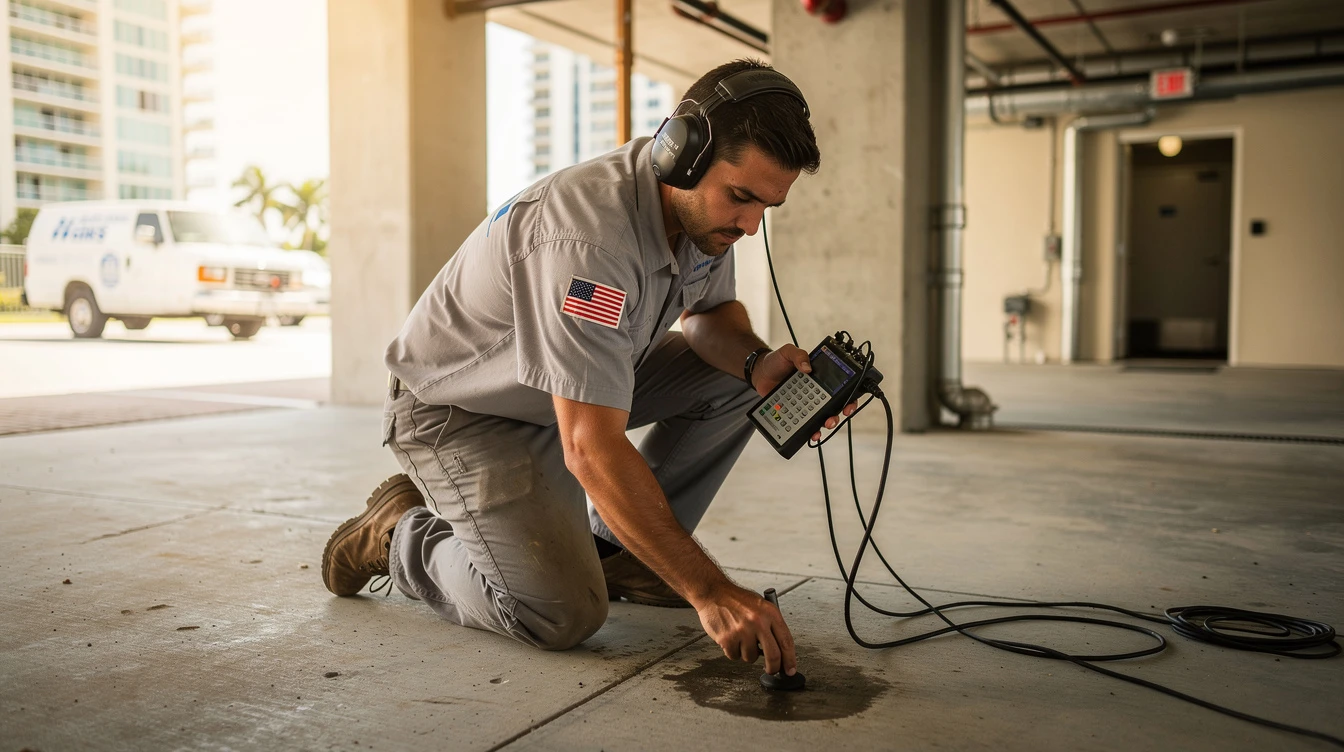
Coastal homes need extra caution: On a slab foundation, water from a base leak spreads sideways into flooring and cabinet bases before you ever notice it. In a condo building, that same water can end up in the ceiling of the unit below. Our leak detection service can pinpoint hidden moisture before it becomes a much larger repair.
Drips behind the tank: the mounting gasket
Notice water running down behind the toilet or pooling on the wall side? That's usually the large rubber gasket that joins the tank to the bowl, held in place by two mounting bolts. As the rubber ages and the bolts corrode, water weeps out of that seam every time the tank refills.
Dry the joint completely and watch for droplets forming right at the bolt heads or along the seam. A slight snug of the bolts sometimes stops it, but push too hard and you risk cracking the porcelain tank, which turns a minor repair into buying a whole new toilet. Swapping the gasket itself is possible for a confident DIYer, but it's fiddly enough that most homeowners hand it off.
Slow drips from the supply line
The flexible hose running to the tank, and the shut-off valve it connects to, are common sources of a slow, clean drip. You'll notice a thin trail of water under the valve or where the line meets the tank, with no odor at all.
Safe to handle yourself
- Snug a loose supply nut by hand, then a small wrench turn if it still drips.
- Replace a bulging or corroded braided line with a new one.
- Swap out a hardened flapper or aging fill valve.
Time to call a plumber
- A shut-off valve stuck open or leaking around the stem itself.
- Anything involving the wax ring, a cracked bowl, or a damaged flange.
- Water that has already soaked into the floor, wall, or a neighboring unit.
The tank that won't stay quiet
Not all leaks land on your floor. If the toilet hisses on its own, refills randomly, or you hear a faint flush sound in the middle of the night, water is leaking internally from the tank straight into the bowl. Nine times out of ten the cause is a worn flapper, the rubber flap at the tank's bottom that no longer forms a tight seal.
Test it yourself: drop a bit of food coloring into the tank water and wait fifteen minutes without flushing. Color showing up in the bowl confirms the flapper is the problem. It's one of the easiest and cheapest repairs on this list, but ignoring it quietly inflates your water bill month after month and wears out the fill valve faster.
Sweating isn't leaking. South Florida humidity meets a cold tank and the outside surface beads up with condensation that can look exactly like a leak. Dry the tank off completely: a steady stream running from one specific seam means a real leak, while an even film across the whole surface is just humidity doing its thing.
When the toilet is just the messenger
Sometimes the toilet itself is fine and the real problem is downstream. A partial drain clog can push water backward and out around the base, mimicking a failed wax ring almost perfectly. If other fixtures in the house are also slow or gurgling whenever the toilet drains, you're likely dealing with a line issue that needs professional drain cleaning rather than a new seal.
If you're also spotting soft baseboards, an oddly warm patch of slab, or a water bill that jumped for no clear reason, the toilet may only be one symptom of something bigger going on behind the walls. Our guide covering early signs of a hidden water leak breaks down what to look for throughout the rest of the house.
When to stop troubleshooting and call
A running tank or a dripping supply line is usually something you can knock out in an afternoon. Water pooling at the base, a wobbly toilet, a cracked tank, or moisture that's already reached the floor is a different story, and calls for a licensed plumber right away. On a coastal slab or inside a condo, hidden water damage builds up fast and quietly, so shut the valve, mop up, and pick up the phone. It's a fraction of the cost of repairing rotted subfloor.
Hallandale Emergency Plumbing SFL fixes toilet leaks throughout the area, from a quick reset to chasing down water that shouldn't be there. Call us any time at (954) 613-1030. CFC1433655.
More reading
A few more guides to help you spot plumbing trouble before it spreads.
The Overview
The Full Home Plumbing Guide
Everything on leaks, clogs, and repairs, gathered in one place.
Read moreRelated Guide
Signs of a Hidden Water Leak
Warm slab spots, soft drywall, rising bills: catching leaks you can't see directly.
Read moreService
Leak Detection
Locating moisture inside walls, floors, and slabs before it turns into damage.
Learn moreService
Drain Clogs
When a stubborn line backup pretends to be a leaking toilet.
Learn moreLeak Getting Worse?
Stop a toilet leak before it reaches the floor.
(954) 613-1030Licensed & Insured. CFC1433655. Serving Hallandale Beach and South Florida