Plumbing Survival Guide
The Hallandale Beach Homeowner's Guide to Surviving a Plumbing Emergency
Salt air, high water tables, and decades-old pipe runs make plumbing failures a different animal this close to the coast. This guide walks you through the calm, practical steps for the moment a supply line lets go, a drain stops draining, or your water heater quits: written for slab homes, humid crawlspaces, and the tidal soil under Hallandale Beach.
Step one: find your shutoff, not your phone
Do this before the water rises
Every plumbing scare gets smaller the moment the water stops moving. That means the single most useful thing you can do for your home isn't a tool or a app: it's knowing where the main shutoff sits and testing it while things are quiet. On most Hallandale Beach houses the main valve is mounted on an exterior wall close to where the service line enters, frequently near the garage or laundry side of the house. Give it a firm clockwise turn until it stops moving.
Condo and townhome owners often have a separate story: your unit stop may be inside a utility closet or behind an access panel rather than outdoors, so ask your association or a technician to point it out ahead of time. Houses on municipal service also have a curb valve at the meter, typically under a small lid near the sidewalk, opened with an inexpensive meter key. And every sink, toilet, and washer should have its own small angle stop nearby. Find all three levels of control now, while nothing is dripping.
Try this today:Walk the house and physically operate every valve you can reach. A stiff handle, a stripped stem, or a valve that spins loose without shutting anything off is a small job now and a flood-day disaster later. If you find one, an emergency plumbing visit to swap it out is far cheaper than the cleanup it prevents.
Five plumbing failures that can't wait until Monday
Most plumbing issues can hold for a scheduled appointment. These five can't. If any of them are happening right now, secure your family, cut the water, and call us at (954) 613-1030, day or night.
1. A supply line lets go
A ruptured supply pipe can send water through drywall and flooring in minutes, not hours. Close the main immediately, crack open a faucet lower in the house to bleed off pressure, and get furniture and rugs clear of the water. Corrosion and pinhole failures both tend to strike at fittings first, and older copper is especially vulnerable in our mineral-heavy water. Regular leak detection catches the weeping joint long before it becomes the burst pipe: one is a footnote, the other is a claim to your insurer.
2. Sewage rises instead of drains
Dark, foul water surfacing in a tub, floor drain, or your lowest toilet, especially timed with a flush or a washing machine cycle, means the sewer line itself is blocked or breaking down. Treat it as a biohazard: stop using water in the house and keep kids and pets away from any standing wastewater. Older lateral pipe in this area is prone to root intrusion and sagging; sometimes clearing the line solves it, and sometimes the fix is trenchless sewer repair done from the surface without tearing up your yard.
3. The water shuts off, and it's not the whole street
If neighbors still have service but your house doesn't, suspect the pressure regulator, a valve that got bumped, or a hidden line dumping supply somewhere out of sight. Check the meter dial with every fixture in the house closed: if it's still spinning, water is escaping and you need a locate, not a guess. A slab leak hunting a path to daylight will happily rob your pressure until it finds one.
4. Your gas water heater is weeping
A leaking gas water heater combines a flood risk with a combustion risk. If you smell gas, get everyone outside first and call the gas company from your driveway, not from inside. If it's just water pooling under the tank, close the cold inlet valve on top of the unit and switch the gas control to pilot or off. Once a steel tank starts rusting through at the seams, patching rarely holds; a same-day water heater replacement is usually the honest answer.
5. Something's wrong under the floor
A slab leak rarely announces itself with a puddle. Instead you get a warm patch of tile, a faint hiss when the house is silent, a musty smell that won't go away, or a water bill that spikes without an obvious reason. Left unaddressed it can undermine flooring and feed mold behind baseboards. Targeted leak detection finds the exact spot using acoustic and thermal tools, so the repair opens one section of floor instead of the whole room.
While we're on our way
What to do in the gap between the call and the truck
Once you've dialed us, the time before a technician arrives is yours to use wisely. Here's the order that actually protects your home:
- Make sure the main valve is fully closed and crack a low faucet to release built-up pressure.
- If water is anywhere near outlets or your panel, cut power at the breaker with dry hands, never in standing water.
- Clear rugs, boxes, and electronics off the wet area and lift fabric edges off soaked floors.
- Snap a few photos before you start mopping. Your insurance adjuster will ask for them.
- Soak up what you safely can with towels, but stay out of any pooled water anywhere near live circuits.
- Unlock the gate, clear the driveway, and put pets in another room so our tech can get to work fast.
Skip the store-bought drain chemical, even if the temptation is strong. Caustic cleaner sitting on top of a fully blocked line can splash back on you or a technician once the clog finally breaks loose. A stubborn stoppage responds far better to proper drain cleaning or hydro jetting. Keep your phone on you: we can often talk you through stabilizing things while we're on the road at (954) 613-1030.
Understanding what's actually behind your walls
The systems that fail, and how they warn you first
You protect your home better once you understand what's inside it. Four systems generate nearly every call we get in Hallandale Beach, and each one gives off warning signs long before it fails completely. Learn the signals and you'll catch trouble on your schedule instead of the pipe's.
Drain and sewer lines
Drains work on gravity and a clear path. Grease, hair, mineral buildup, and, outside, invasive tree roots narrow that path over time until water has nowhere to go. When several fixtures slow down at once, that's a main-line symptom, not an isolated clog. A recurring backup usually means roots have found their way in or a section of pipe has settled, which is exactly the job for hydro jetting or a camera inspection. If the same drain clog keeps coming back, the pipe is trying to tell you something bigger is wrong.
Water heaters
Sediment builds up faster in our climate than most homeowners expect, coating the burner or element, driving up energy use, and slowly rusting the tank from the inside. Popping sounds, water that arrives rusty, or a noticeably longer wait for hot water are the early tells. Most tanks last somewhere around a decade; running one well past that is how a quiet Tuesday turns into a flooded garage. Compare the real cost of repair against a straightforward replacement before sinking money into an aging unit.
Older pipe materials
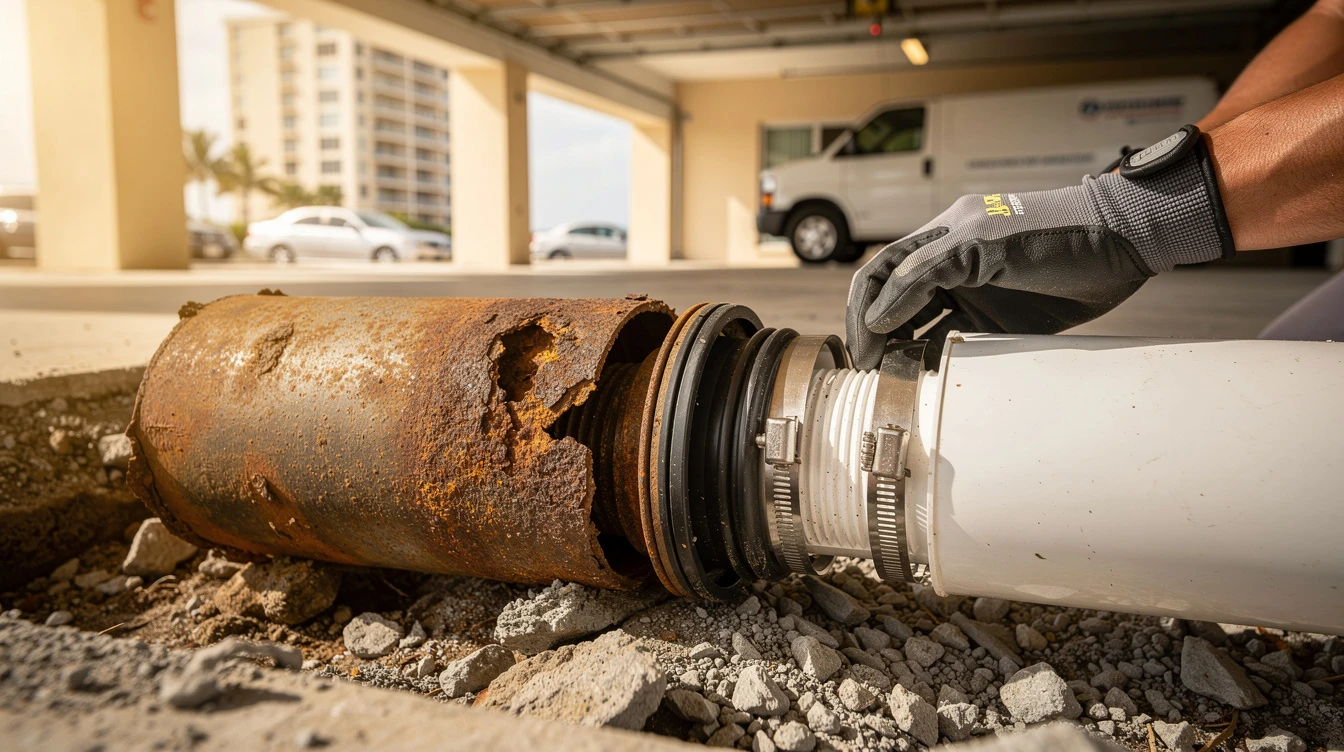
Plenty of homes in this stretch of Broward County still run original cast iron drain lines from decades back. Over time the interior surface scales up, cracks, and channels, breaking down the pipe from the inside long before the outside shows any sign. Persistent sewer odors, repeat backups, and rust stains bleeding through slab or grout are the clues. Once a system reaches that point, patch repairs buy weeks at best; planned cast iron pipe replacement is what actually stops the cycle.
Leaks you can't see
Not every leak makes a puddle. The costly ones seep quietly behind drywall or beneath the slab for months, feeding mold and weakening structure while the house looks fine from the outside. Watch for a water bill that climbs without explanation, a faint sound of running water when nothing is on, or a spot on the floor that stays warm or damp. A meter that keeps ticking with every valve closed confirms it. Acoustic and thermal leak detection pinpoints the source before it turns into the kind of repair that shuts down a room for a week.
The short version:Know your shutoffs, take the five emergencies seriously, and treat early warning signs as a chance to act, not a nuisance to ignore. When you do need help, we're answering calls across Hallandale Beach around the clock. Save(954) 613-1030 in your phone, and check the field guides below for the details on each problem.
Go deeper
Four guides that break down the problems Hallandale Beach homeowners run into most, with the diagnosis, the cost, and the next step.
Guide 01
Is your toilet quietly wasting water?
How to catch a running toilet before it shows up on your bill.
ReadGuide 02
Signs of a hidden water leak
The bills, sounds, and stains that mean water is escaping somewhere out of sight.
ReadGuide 03
What a new water heater really costs
Repair versus replace, tank versus tankless, and the factors that move the price.
ReadGuide 04
When cast iron pipes finally give out
Why old drain lines fail from the inside, and when replacement makes more sense than another repair.
ReadAnswering calls 24/7
A plumbing emergency doesn't check the clock. Neither do we.
(954) 613-1030Hallandale Emergency Plumbing SFL · 601 Silk Run Unit 1520, Hallandale Beach, FL · CFC1433655